Loading... Please wait...





- Cycling Shoes
- Cycling Clothing
- Bike Parts
- Cassettes
- Pedals
- Cleats and Accessories
- Bike Chains
- Mudguards
- Saddles
- Seatposts
- Road Handlebars
- Handlebar Tape
- Handlebar Grips
- Bike Stems
- Inner Tubes
- Puncture Repair
- Bike Cables
- Road Wheelsets
- Brakes
- Mountain Bike Forks
- Bottom Brackets
- Bike Care and Maintenance
- Track Pumps
- Bike Tools
- Cycling Multi-Tools
- Mini Pumps and Co2
- Bike Tyres
- Cycling Helmets
- Cycling Accessories
- Car Bike Racks
- Turbo Trainers
- Bike Boxes
- Road Bikes
- Orro Parts and Accessories
- Kids Bikes
- Children's Bicycle Seats
- SALE
Blog - measure feet
How to Measure Feet for Cycling Shoes: A 2026 Guide
Posted on 24th Sep 2026
Table of Contents
- What You'll Need to Measure Feet Accurately
- Step-by-Step: How to Measure Your Feet for Cycling Shoes
- How Should Cycling Shoes Fit? Key Differences from Everyday Footwear
- Cycling Shoe Width Guide: Why Width Matters More Than Length
- Common Cycling Shoe Fit Mistakes to Avoid
- Using a Shoe Fit Tool to Confirm Your Size
- Conclusion
- Frequently Asked Questions
Last Updated: September 24, 2026
What You'll Need to Measure Feet Accurately
Getting the right cycling shoe starts long before you browse a product page. Learning how to measure feet for cycling shoes is the single most useful thing you can do to avoid painful rides and expensive returns. At Salt Dog Cycling, we talk to riders every day who've bought the wrong size twice before finally measuring properly.

Foot measurement is the practice of recording your foot's length and width in millimetres, ideally at the end of the day when your feet are at their largest. It takes five minutes and saves months of discomfort.
Here's what to gather before you start:
- A hardback book or similar
- A ruler or tape measure marked in millimetres
- A wall or skirting board to press your heel against
- A friend to help, if you can find one
- The socks you actually ride in
That last item matters more than people expect. A thick winter sock can add several millimetres to your foot's width. Measure in the socks you'll wear most.
Do this in the evening. Feet swell through the day, so a morning measurement often reads smaller than your true riding size, or take a few readings throughout the day.
Step-by-Step: How to Measure Your Feet for Cycling Shoes
The best place to start when looking at Cycling shoes is to measure your feet. Everyone’s feet are different.
Take your foot measurement while wearing your cycling socks and follow the instructions below.
Step 1: Length measurement.
To measure your foot length the best technique we’ve found is:
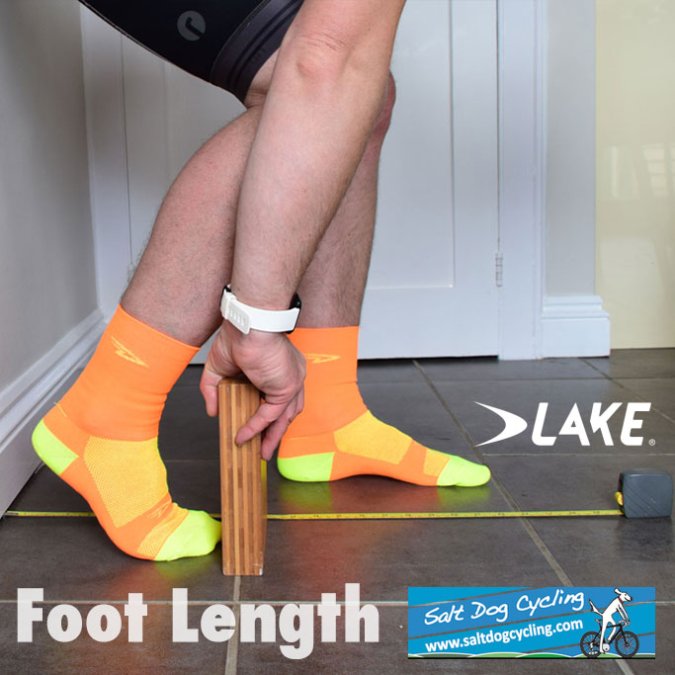
Cyclist tracing the outline of their bare foot on paper is NOT completely accurate, so use this method instead.
Measuring Foot Length
- Put your heel against a wall
- Lift your heel off the ground with your knee bent and push forward.
- Then put a book in front of your toes and measure to the book.
(This is your downward pedal stroke. The foot goes forward slightly.)
- Repeat for the other foot and use the longer measurement.
Most people have one foot slightly bigger than the other. Always size to the larger foot, never the smaller one.
All measurements need to be in mm as there is 6mm between full sizes and 3mm between half sizes.
Measuring Foot Width at the Widest Point
Step 2: Width measurement.
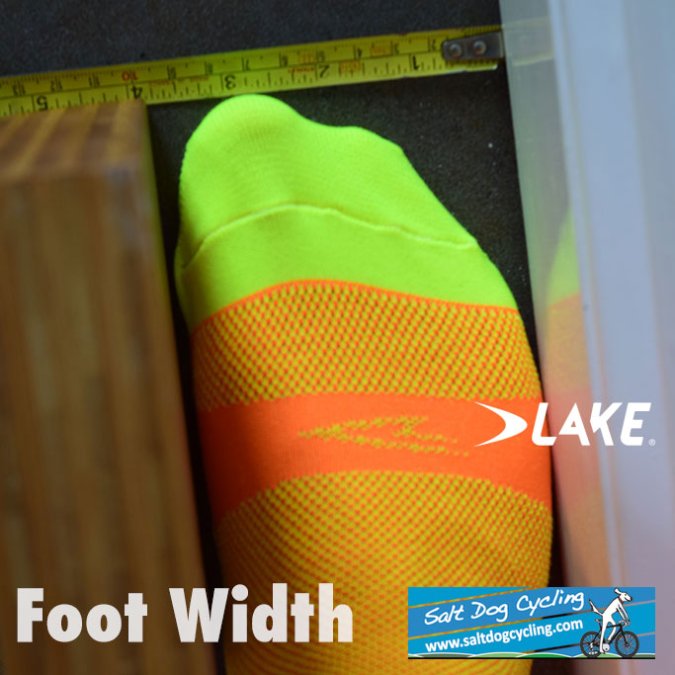
- To measure the width, put your foot sideways to the wall, put a book down and measure straight across.
- (with the width try not to push the foot into the wall just touch the wall)
- Typically you will want shoes that accommodate your largest foot the most comfortably.
- Please Note: For accurate measurement please obtain a 3 digit millimetre measurement.
- example: 267mm will provide the correct amount of data.
- Accurate measurements cannot be obtained from only 2 digits.
example: 26cm does not provide enough data to determine size.
Width is where most sizing goes wrong. A shoe that's the right length but too narrow will cause numbness, hot spots and tingling toes on longer rides. If your width measurement sits well above average for your length, look at wide-fit options from the start rather than hoping a standard shoe will stretch.

How Should Cycling Shoes Fit? Key Differences from Everyday Footwear
Cycling shoes should fit snugly around the heel and midfoot while leaving room for your toes to spread. That's the opposite of how most people shop for trainers, where a bit of slip feels comfortable.
Three differences catch riders out:
- Heels shouldn't lift. In a running shoe, a little movement is fine. On a bike, a lifting heel means lost power and rubbed skin.
- Toes need room to spread. Your foot expands under load. A shoe that feels tight standing still will feel tighter after an hour.
- The closure does the work. Boa dials and straps should hold your foot, not squeeze it. If you're cranking them down to stop movement, the shoe is the wrong shape.
You should be able to wiggle your toes slightly. If you can't, go up half a size or switch to a wider fit.
Cycling Shoe Width Guide: Why Width Matters More Than Length
Width decides comfort far more than length does. A shoe that's 5mm too long is annoying. A shoe that's 5mm too narrow is unrideable after 30 minutes.
Cycling shoes are built on lasts, which are the foot-shaped moulds the shoe is constructed around. Most standard lasts suit a narrower foot. Riders with bunions, wide forefeet or Morton's Syndrome often need a wide-fit last instead.
Foot Type | What to Look For | Why It Matters |
|---|---|---|
Narrow forefoot | Standard last | Avoids excess volume and slipping |
Average width | Standard, half size up if unsure | Balances hold and room |
Wide forefoot | Wide-fit last | Prevents pinching at the ball |
Bunions or Morton's Syndrome | Wide-fit plus adjustable closure | Reduces pressure on sensitive areas |
This is where a proper fit tool earns its keep. The Lake [Shoe Fit Tool(https://lakeshoefit.saltdogcycling.com/) | lakeshoefit.saltdogcycling.com] lets you enter your measurements and get a size recommendation before you order. It's free to use and takes a couple of minutes.
Common Cycling Shoe Fit Mistakes to Avoid
Most bad shoe purchases trace back to the same handful of errors. Here are the ones we see constantly.
- Measuring in the wrong socks. Thin summer socks and thick winter socks give different numbers.
- Sizing to your smaller foot. Always use the longer, wider measurement.
- Trusting your trainer size. Cycling brands use their own lasts, so a size 43 in one shoe is not a size 43 in another.
- Buying tight to "break them in". Cycling shoes are stiff by design. They don't stretch like leather walking shoes.
- Ignoring width entirely. Length gets all the attention, but width causes most of the pain.
- Measuring while seated. Your foot spreads when you stand and load it.
Using a Shoe Fit Tool to Confirm Your Size
A fit tool turns your two measurements into a size recommendation in seconds. You enter your foot length and width, and it matches you to the right last and size.
This matters most if you're between sizes or have a wide forefoot. Guessing at that point usually means ordering two pairs and sending one back.
If you'd rather talk it through, that's what we're here for. Salt Dog Cycling is run by cyclists, and you can call the team on +44 (0)1332 739747 or email info@saltdogcycling.com with your measurements. We'll point you towards the right fit, whether that's a standard last or a wide-fit model like the Lake MX177 Wide Fit Mountain Bike Shoes or the Lake CX242 Road Cycling Shoes.
Conclusion
Getting your measurements right takes five minutes and prevents the most common cycling shoe problem there is: a shoe that fits in the shop and hurts on the road. Measure at the end of the day, in your riding socks, and record both length and width before you buy anything.
If you're unsure, use the free Lake Shoe Fit Tool to check your size, then browse the range at Salt Dog Cycling. We're a family-run shop run by cyclists, we offer free delivery on all orders, and we're happy to talk through your measurements before you commit. Create an account today and get expert help choosing shoes that fit properly from the first ride.
Frequently Asked Questions
Should cycling shoes be a size bigger than normal shoes?
Not necessarily. Cycling shoes should fit snugly around the heel and midfoot, with about 5mm of space at the toe. This is often similar to your everyday shoe size, but brands vary. Always measure your feet and check the specific brand's size chart. If you have wide feet, look for wide-fit options rather than sizing up, as a larger size may be too long and cause heel slip.
How much room should be in the toe of a cycling shoe?
Aim for 5mm of space between your longest toe and the front of the shoe. This allows for foot swelling during rides and prevents toe numbness. Less than 3mm can cause pressure points; more than 10mm may let your foot slide forward, leading to discomfort or hotspots. Always measure your feet at the end of the day when they are at their largest.
Do cycling shoes stretch over time?
Most modern cycling shoes use synthetic materials that do not stretch significantly. Leather models may give slightly, but you should not rely on this. Buy shoes that fit correctly from the start. If a shoe feels tight in the width, it will likely remain tight. Choosing a wide-fit model from the outset is a better solution than hoping for stretch.
Is there a difference between road and mountain bike shoe sizing?
Sizing can differ between road and mountain bike shoes, even within the same brand. Road shoes often have a narrower, more race-oriented fit, while mountain bike shoes may be slightly roomier for walkability. Always measure your feet and consult the specific model's size guide. If you switch between disciplines, measure again rather than assuming your size carries over.

Copyright 2026 Salt Dog Cycling. All Rights Reserved. Sitemap |